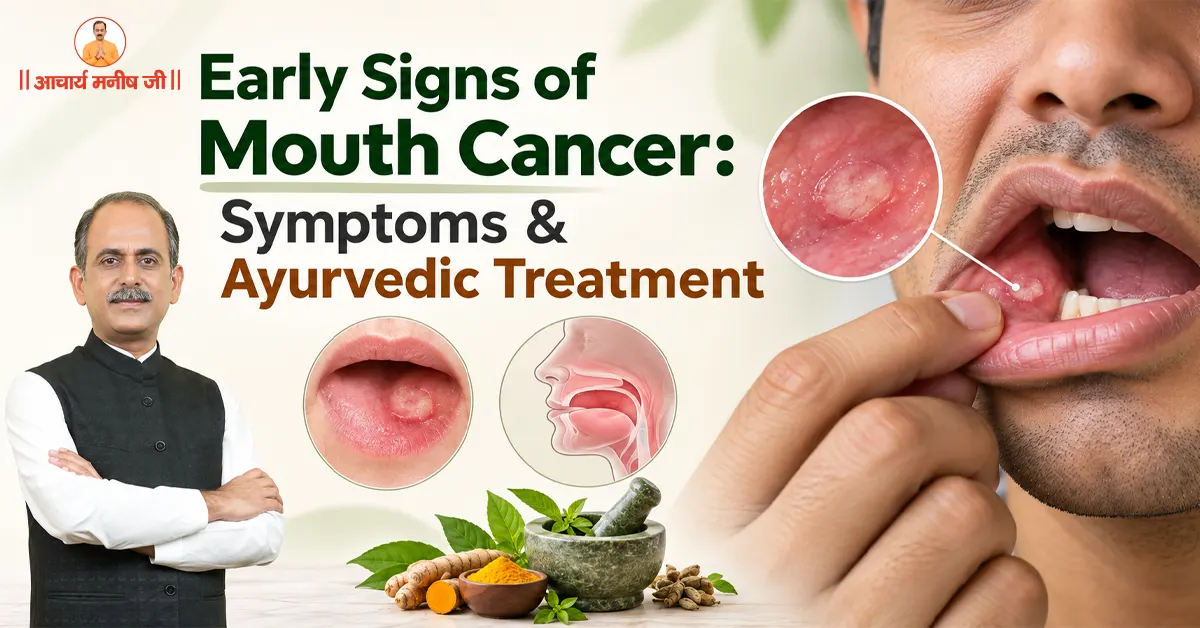

Mouth cancer often begins quietly. Any sign of mouth cancer can look like a minor sore or a harmless patch, so many people ignore it. Acharya Manish Ji teaches that the body gives small signals before a disease takes hold. So learning to read these signals early is the first step toward better care.
The need for awareness is clear in India. A review of Early Detection of Oral Premalignant and Malignant Lesions in India notes that oral cancer is the most common cancer and the leading cause of cancer death in Indian men. It links this burden mainly to smokeless tobacco and areca nuts. It also points to poor awareness and late presentation.
This blog covers the early signs, tongue symptoms, causes, and stages of mouth cancer. It also covers the Ayurvedic view and Acharya Manish Ji’s supportive approach.
What Is Mouth Cancer? Understanding It Through Acharya Manish Ji’s Vision
Mouth cancer, also called oral cancer, is an abnormal growth of cells in the mouth. It can start in the lips, tongue, cheeks, gums, palate, or floor of the mouth.
Ayurveda describes mouth diseases under Mukharoga and cancer-like growths under Arbuda. Acharya Manish Ji links such growths to weak digestion, a build-up of toxins called Ama, and imbalanced doshas. So he looks at the whole body and not only at the mouth. Therefore, he sees every sign of mouth cancer as a message from within.
Get guidance on your health from Acharya Manish Ji and his team. Book your consultation today.
Early Signs of Mouth Cancer: 7 Symptoms You Should Not Ignore
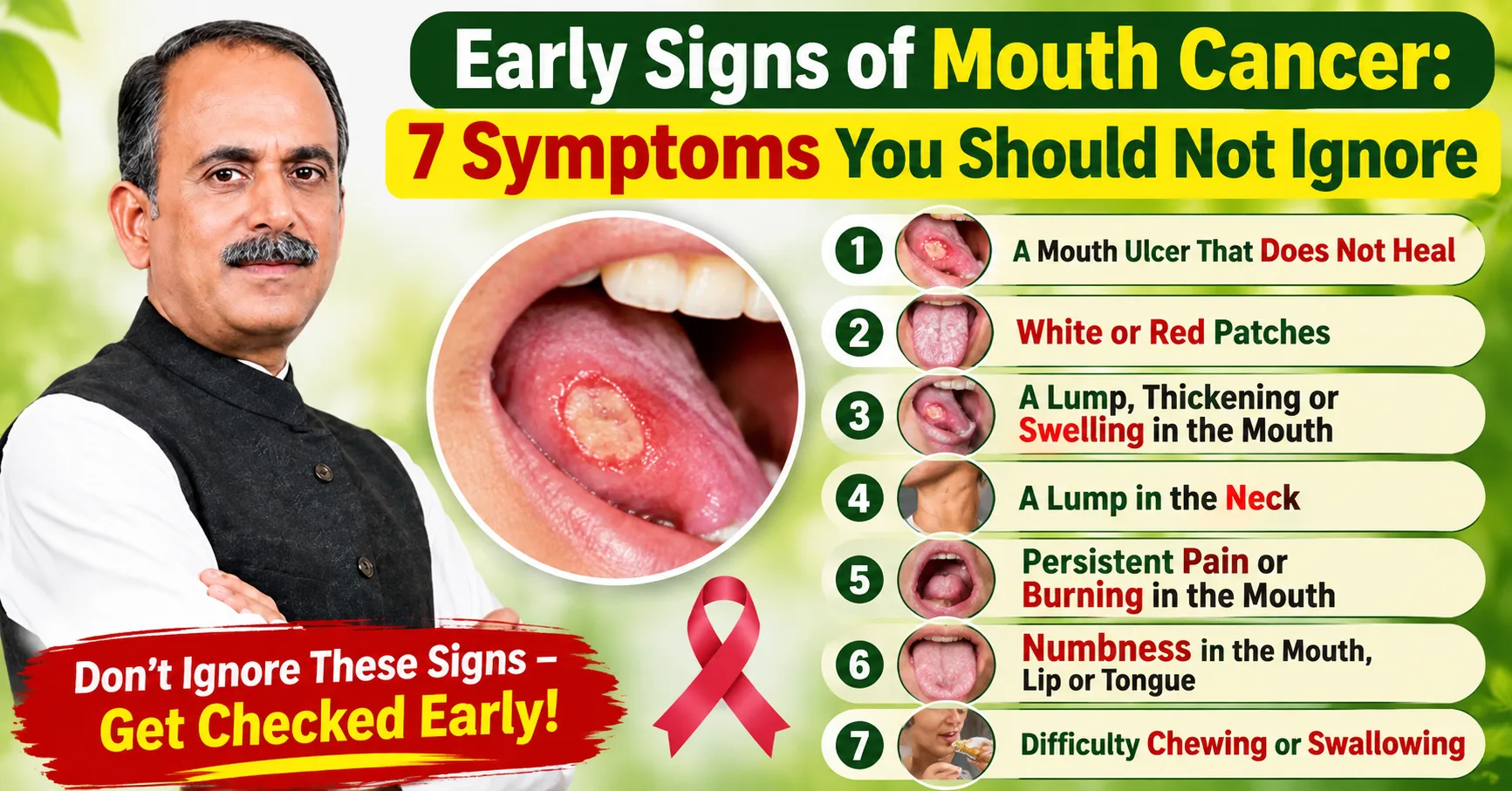
The early signs of mouth cancer often look harmless. As a result, people delay a visit to the doctor. These oral cancer symptoms are also the mouth cancer warning signs to act on. Many of them cause no pain at first, so they are easy to miss.
1. A Mouth Ulcer That Does Not Heal
An ulcer that lasts more than two weeks is the most common early sign. A common ulcer is usually painful from the start and heals on its own. However, an early cancerous ulcer may not hurt at all, so people ignore it.
2. White or Red Patches
A white or red patch on the gums, cheeks, tongue, or floor of the mouth should not be ignored. Doctors call these leukoplakia, which is white, and erythroplakia, which is red. They can sometimes be early changes. Also, they may cause no pain, so people rarely notice them.
3. A Lump, Thickening or Swelling in the Mouth
A lump or thick area on the lip, tongue, cheek, or gum can be a warning sign. It may feel firm and stay in one place. People often assume it is a minor injury or a boil.
4. A Lump in the Neck
A swelling on one side of the neck can mean the disease has reached the lymph glands. It may be painless. So any neck lump that stays for more than two weeks needs a check.
5. Persistent Pain or Burning in the Mouth
Constant pain, soreness, or a burning feeling in the mouth is another sign. Spicy or hot food may feel unusually harsh. People often blame acidity or a common mouth ulcer.
6. Numbness in the Mouth, Lip or Tongue
A numb or tingling area in the mouth, lip, or tongue should not be ignored. It may appear without any injury or dental work. It may point to a bigger change, so it needs a doctor’s check.
7. Difficulty Chewing or Swallowing
Food may feel stuck, or chewing may become painful. Swallowing can also feel harder than before. People often think it is a dental or throat problem, and they delay a check.
Any sign of mouth cancer that lasts more than two weeks needs a doctor’s examination. The same applies to unexplained weight loss. Tests confirm the diagnosis.
Understand your body’s signals with guidance from Acharya Manish Ji and his team.
Tongue Cancer Symptoms: Signs Specific to the Tongue
The tongue can also be affected. Tongue cancer symptoms are similar to the signs above, but they appear on the tongue itself. Watch for these changes:
- A sore or ulcer on the side of the tongue that does not heal
- A red or white patch
- A lump or thick area
- Pain, bleeding or numbness
- Trouble moving the tongue, chewing or speaking
Because the tongue moves all day, a sore there may seem to heal and then return. A sore that keeps returning also needs checking. In Ayurveda, Jihwa, the tongue, is one of the seven sites of Mukharoga. So changes on the tongue deserve the same care.
Mouth Cancer Causes: Habits That Raise the Risk
Mouth cancer has several causes. According to Oral cancer in India continues in epidemic proportions, India has the highest number of oral cancer cases in the world. The review links the disease mainly with tobacco use. In addition, other risk factors include areca nut, alcohol, human papillomavirus (HPV), age, male gender, and social factors.
Acharya Manish Ji adds the role of daily habits. In his view, wrong food, a poor routine, and long-term stress weaken digestion. As a result, Ama builds up and disturbs the doshas. Besides, chewing tobacco or areca nut irritates the mouth again and again. Over time, such habits can strain the body. So small changes in food and routine matter.
Mouth Cancer Stages: How the Disease Progresses
Doctors describe mouth cancer in stages, from 0 to IV. The stage shows how far the disease has spread. In simple words:
- Stage 0: Abnormal cells are only on the surface layer of the mouth.
- Stage I and II: A small or medium growth, with no spread to the neck glands.
- Stage III: A larger growth, or spread to one gland in the neck.
- Stage IV: Spread to nearby structures, several glands, or other parts of the body.
Therefore, doctors set the stage after tests. In Ayurveda, Arbuda is described by the dosha and tissue involved. This is a different way of reading the same disease.
Ayurveda’s View of Mouth Cancer
Ayurveda describes cancer-like conditions as Arbuda and Asadhya Vrana, which means non-healing ulcers. The overview paper explains that the wrong diet and lifestyle upset the three doshas. Besides, types of Arbuda are named by the tissue involved. It also says that untreated Arduba may turn into Asadhya Vrana.
Acharya Manish Ji explains this process through digestion. When Agni, the digestive fire, is weak, Ama forms. Ama blocks the body’s channels, called Srotas. In Mukharoga, Kapha is the main dosha. So, any lasting sign of mouth cancer is considered a sign of a deeper imbalance.
Next, let us see how Acharya Manish Ji approaches care.
Ayurvedic Treatment for Mouth Cancer: Acharya Manish’s Approach

Acharya Manish Ji works on the root cause. His approach is supportive care that works on digestion, Ama, and the doshas.
Golden Therapy
Golden Therapy is a foot-churning therapy. A herbal paste of leaves and raw turmeric is gently churned with the feet. It is described as a supportive detox practice.
Cancer Detox Juice
This is a fresh, raw juice of medicinal leaves, leafy greens, raw turmeric, and amla. It is taken in the morning.
Aahar (Diet)
Fresh, light, and warm food is easier to digest. For example, fruits, vegetables, and millets fit this plan. Tobacco, gutka, alcohol, and processed food are kept away. Regular meal times also help.
Shaman (Herbs)
Herbs such as turmeric, tulsi, giloy and amla are traditionally used to support the body. However, a trained Ayurvedic doctor must choose the herbs and the dose.
Shodhan (Cleansing)
Shodhan means cleansing therapies. It is done only after a doctor’s full assessment. For example, a weak patient may need a gentler plan.
Vihar (Routine and Mind-Body Care)
A fixed sleep time, light movement, yoga, pranayama, and meditation support the body and calm the mind. Also, stress care is part of the plan.
Learn how Ayurvedic support can fit alongside your care plan. Connect with Acharya Manish Ji’s team today.
Everyday Tips to Lower Your Risk of Mouth Cancer
You can reduce many causes of mouth cancer by changing your habits. These simple steps help, and each one is easy to start today:
- Quit tobacco, gutka, and pan masala.
- Avoid areca nut, also known as supari.
- Limit or avoid alcohol.
- Brush twice a day and keep the mouth clean.
- Check your mouth in a mirror every month for sores, patches or lumps.
- Have regular dental check-ups.
- Eat fresh food and keep a steady routine.
Conclusion
Mouth cancer often starts with small changes that people ignore, such as an ulcer that stays or a patch that does not fade. That is why Acharya Manish Ji asks people to listen to their bodies early. A sign of mouth cancer that lasts beyond two weeks deserves a doctor’s check. Daily habits, such as light food, a steady routine, and a tobacco-free life, then support the body alongside Ayurvedic care.
Good health begins with the right knowledge and steady habits. Take the next step with guidance from Acharya Manish Ji and his team. Book your consultation today.
FAQs
1. What are the common oral cancer symptoms?
A mouth ulcer that does not heal in two weeks, white or red patches, a lump and constant pain or burning are common. Numbness, trouble chewing or swallowing, and unexplained bleeding can also occur.
2. What are the mouth cancer warning signs that need a doctor’s check?
Any change in the mouth that lasts more than two weeks needs a check. A lump in the neck, unexplained bleeding, and unexplained weight loss also need prompt attention.
3. What causes mouth cancer?
Tobacco, areca nut and alcohol are the main risks. HPV and poor oral hygiene can add to the risk. Acharya Manish Ji also points to weak digestion, Ama build-up, stress, and daily habits.
4. What are the mouth cancer stages?
Doctors describe it in stages from 0 to IV, based on how far the disease has spread. Tests set the stage, and it cannot be judged by looking at the mouth.
5. How does Ayurveda view mouth cancer?
Ayurveda describes cancer-like conditions as Arbuda and non-healing ulcers as Asadhya Vrana. Acharya Manish Ji looks at the root cause through digestion, Ama, and the doshas. This is a traditional view, with no claim to diagnose or treat.